
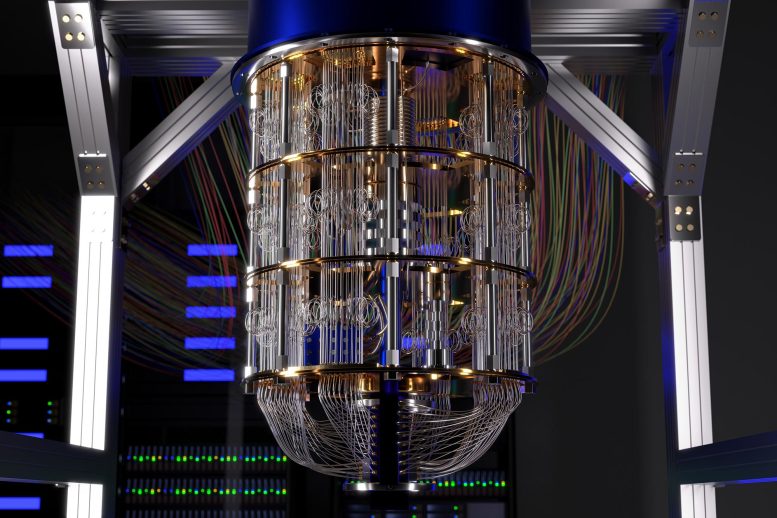
Quantum computing has reached another important milestone as researchers from IBM and the University of Chicago demonstrate a quantum computation that appears to be beyond the practical capabilities of leading classical simulation methods.
The calculation was completed in approximately 15 minutes on a quantum computer. For comparison, researchers found that simulating the same type of computation using leading classical approaches would require an impractical amount of time and computational resources.
But the speed of the calculation is only one part of the story.
What makes the experiment particularly significant is that the researchers also addressed one of the biggest challenges facing modern quantum computing: how to verify that a quantum computer has actually performed a difficult calculation correctly.
As quantum circuits become more complicated, checking their results using classical computers can become almost as difficult as performing the original calculation. The IBM and University of Chicago team therefore designed an approach that aims to make the computation difficult for classical machines while still allowing researchers to estimate how faithfully the quantum computer performed it.
The experiment used 70 logical qubits and demonstrated advanced quantum error-correction techniques. Researchers reported that the logical error rate was reduced to roughly one-tenth of the physical error rate.
The work, described in a paper titled “Sampling hard circuits with verifiably high fidelity,” represents an important step in the development of larger and more reliable quantum computers.
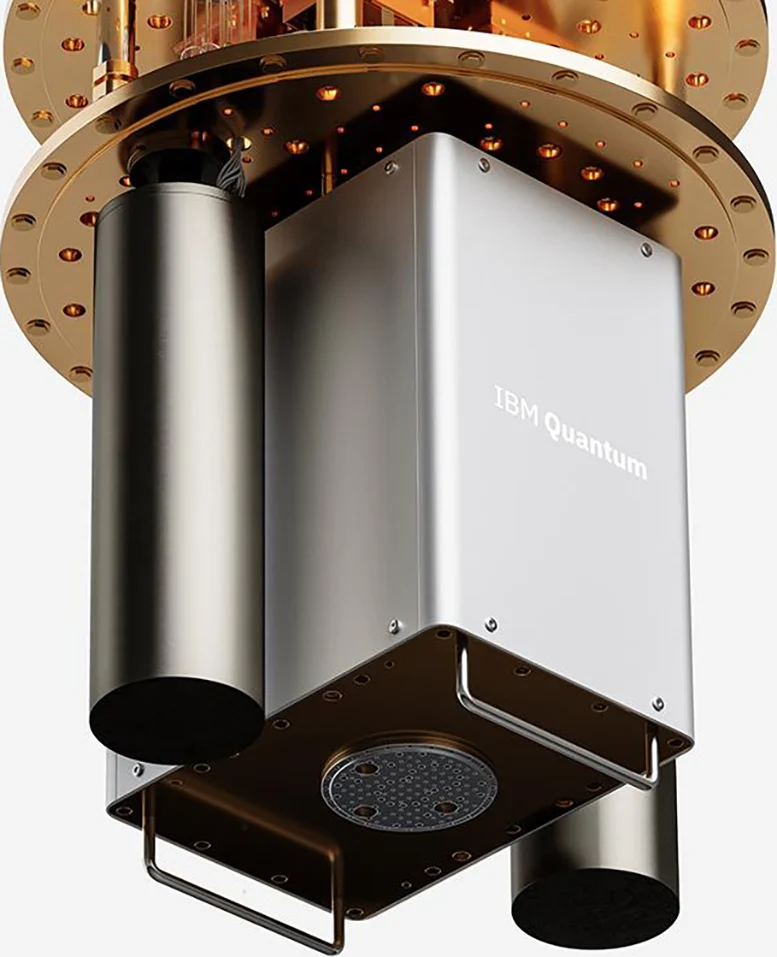
The IBM and University of Chicago team worked on a different approach to address this challenge.
What Exactly Happened?
At its simplest, the experiment demonstrates that a quantum computer can perform a carefully designed computational task that is extremely difficult for today's classical computers to reproduce in practice.
Classical computers process information using bits, which normally represent either 0 or 1. Quantum computers use qubits, which can exist in quantum states that allow them to represent combinations of possibilities and exploit quantum mechanical effects such as superposition and entanglement.
This difference gives quantum computers the potential to approach certain computational problems in fundamentally different ways.
However, building a useful quantum computer is extremely difficult.
Quantum states are fragile. Noise, environmental disturbances and imperfections in hardware can introduce errors into calculations. As a result, simply increasing the number of physical qubits does not automatically produce a more powerful or reliable machine.
Researchers have therefore been working on quantum error correction, a technique designed to protect quantum information from errors.
The latest experiment combines these ideas with a computational problem designed to challenge classical simulation.
Why Is This Considered a Difficult Problem?
One of the traditional ways researchers test quantum computers is through a technique known as random circuit sampling, or RCS.
In random circuit sampling, a quantum computer runs a carefully designed sequence of quantum operations and produces a collection of output results.
For relatively small circuits, classical computers can simulate the process.
But as the number of qubits and operations increases, the amount of information required to reproduce the complete quantum state can grow extremely rapidly.
Eventually, classical simulation becomes computationally expensive.
This creates an interesting situation.
A quantum computer may be able to perform the experiment relatively quickly, while a classical computer trying to reproduce the exact quantum behavior could require an enormous amount of computational power and time.
That difference is one of the foundations behind the concept commonly called quantum advantage.
However, there is a major problem.
If a quantum computer produces a result that is too difficult for a classical computer to reproduce, how can researchers know that the quantum computer got the answer right?
The Verification Problem
This is one of the most important aspects of the new research.
Imagine asking a student to solve an extremely complicated mathematical problem. If you already know the answer, checking the student's work is relatively easy.
But imagine giving the student a problem for which you cannot practically calculate the answer yourself.
Now you have a problem:
How do you know the student's answer is correct?
A similar challenge exists in quantum computing.
Researchers want to demonstrate that quantum computers can perform calculations that classical computers cannot practically simulate. But if the classical computer cannot reproduce the calculation, it becomes difficult to use a classical system as a straightforward reference for checking the quantum result.
This creates a potential verification bottleneck.
The more powerful quantum computers become, the harder some of their computations may be to verify using conventional classical techniques.
The IBM and University of Chicago researchers designed their experiment to address this challenge.
Instead of relying entirely on a direct classical reproduction of the quantum calculation, their approach provides a statistical method for assessing the fidelity of the quantum computation.
Fidelity, in this context, is essentially a measure of how closely the quantum system's actual output corresponds to the intended quantum computation.
This does not mean that every individual output can simply be checked against a classical answer.
Instead, the researchers developed a method for obtaining meaningful statistical information about the quality of the computation.
70 Logical Qubits
Another major part of the experiment was its use of 70 logical qubits.
To understand why this matters, it helps to distinguish between a physical qubit and a logical qubit.
A physical qubit is an actual quantum hardware element.
A logical qubit, on the other hand, is created by encoding quantum information across multiple physical qubits.
The idea is similar to redundancy in conventional computing.
If one piece of information is stored in only one physical component and that component fails, the information may be lost.
But if the information is encoded redundantly across multiple components, errors can potentially be detected and corrected.
Quantum error correction applies a related idea to quantum information, although the underlying mathematics and implementation are considerably more complicated.
The goal is to create logical qubits that are more reliable than the individual physical qubits used to construct them.
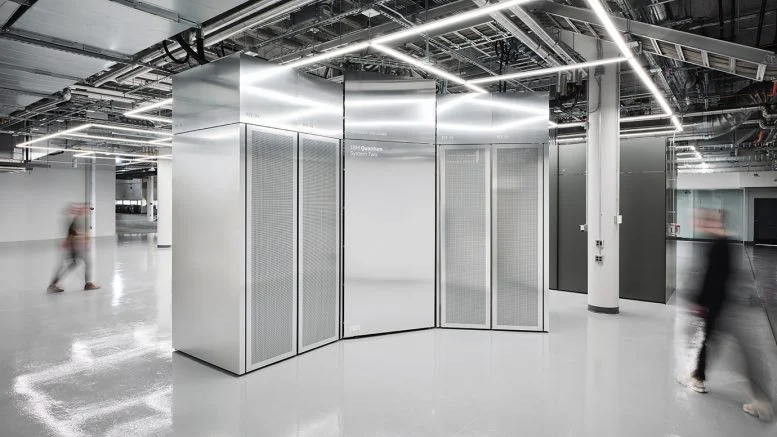
IBM Quantum System Two, a modular quantum computing architecture designed to support the development of larger and more scalable quantum systems.
Why Error Correction Matters
Error correction is widely considered one of the key technologies needed for large-scale quantum computing.
Today's quantum processors are susceptible to errors for many reasons.
Quantum states can be disturbed by interactions with their environment. Hardware imperfections can introduce errors during operations. Even the process of controlling and measuring qubits can affect the quantum state.
As a quantum circuit becomes longer, these errors can accumulate.
Eventually, the result can become unreliable.
Quantum error correction attempts to prevent this from happening by encoding information in a way that allows certain errors to be detected and corrected without destroying the quantum information itself.
The 70 logical qubits used in this experiment demonstrate progress toward that goal.
According to the researchers, the encoding reduced the effective logical error rate to around one-tenth of the physical error rate.
That is important because reducing errors at the logical level is one of the fundamental requirements for building larger quantum systems.
Thousands of Quantum Operations
The experiment wasn't simply a demonstration involving a handful of quantum operations.
The researchers reported carrying out:
- 2,415 logical two-qubit operations
- 468 logical T gates
- 70 logical qubits
These numbers provide an indication of the complexity of the circuit.
Two-qubit operations are particularly important in quantum computing because interactions between qubits allow quantum algorithms to create entanglement and perform complex transformations.
T gates are another important class of quantum operations used in universal quantum computation.
Performing hundreds or thousands of logical operations while maintaining sufficient fidelity is a significant engineering challenge.
The experiment therefore demonstrates progress not only in the number of logical qubits but also in the ability to operate on them repeatedly.
The 15-Minute Computation
According to the researchers, the quantum computation took approximately 15 minutes to complete.
That number may sound surprisingly small considering the complexity of the problem.
However, the important comparison is not simply between 15 minutes and a particular classical computer's runtime.
The researchers compared the quantum computation with leading classical simulation techniques and found that reproducing the calculation classically would require an impractical amount of time.
This distinction is important.
The experiment does not mean that quantum computers can perform every type of computation faster than classical computers.
It also does not mean that classical computers are no longer useful.
Instead, the experiment focuses on a particular class of quantum computation designed to demonstrate a separation between quantum hardware and practical classical simulation.
What Does “Quantum Advantage” Actually Mean?
The phrase quantum advantage is often used in discussions about the point at which a quantum computer can perform a computational task that is practically beyond the capabilities of classical computers.
The term needs some context.
Quantum advantage does not necessarily mean that a quantum computer is universally faster.
A modern laptop can perform many tasks far more efficiently than a quantum computer.
For example, browsing the internet, editing documents, running most business applications and performing ordinary numerical calculations are all tasks for which conventional computers remain extremely effective.
Quantum advantage is instead concerned with particular computational problems where quantum systems can potentially provide capabilities that classical systems cannot practically match.
The IBM experiment focuses on such a specialized problem.
Why the Verification Component Could Be Important
The ability to perform a hard quantum computation is only one part of building a useful quantum computer.
Researchers also need to know whether the machine is performing the computation reliably.
This becomes increasingly difficult as quantum circuits become larger.
Suppose a quantum computer contains thousands or millions of physical components and performs an enormous number of operations.
Even if the final output looks plausible, researchers need reliable methods for determining how much confidence they should place in that output.
This is why verification is such an important research area.
The approach demonstrated by the IBM and University of Chicago researchers attempts to address this problem by combining computational hardness with a mechanism for estimating the fidelity of the quantum process.
In other words, the goal isn't simply:
“We performed a calculation that classical computers can't easily reproduce.”
It is closer to:
“We performed a computationally difficult quantum calculation and developed a method for obtaining statistical evidence about how faithfully it was performed.”
That distinction is crucial.
Researchers' Perspective
University of Chicago Associate Professor Bill Fefferman emphasized the importance of verification in experimental quantum advantage.
His research group worked with IBM researchers on developing techniques for characterizing difficult quantum states in the presence of noise.
The broader objective is to increase confidence in the results produced by increasingly complex quantum processors.
Soumik Ghosh, a PhD student in Fefferman's group, also highlighted the potential importance of improved verification methods as quantum systems continue to develop.
From the IBM side, Jay Gambetta, Director of IBM Research and an IBM Fellow, described the experiment as an important milestone in the development of quantum computing.
These statements reflect the researchers' interpretation of the significance of the experiment, rather than meaning that quantum computing has become universally superior to classical computing.
Does This Mean Classical Computers Are Obsolete?
No.
That would be an inaccurate interpretation of the experiment.
Classical computers remain essential for virtually every aspect of modern computing. They are also used alongside quantum computers.
In many future quantum systems, classical and quantum processors are expected to work together.
Classical computers can handle tasks such as controlling the quantum hardware, processing measurement results, running optimization procedures and performing computations that do not benefit from quantum acceleration.
The experiment instead demonstrates that there are certain specialized calculations where quantum hardware can reach regimes that are impractical to reproduce using classical simulation.
Does This Mean Quantum Computers Can Solve Real-World Problems Now?
Not necessarily.
This is another important distinction.
The demonstrated calculation is primarily a benchmark and research demonstration.
It is valuable because it tests fundamental capabilities of quantum hardware, including:
- logical qubit performance
- error correction
- circuit complexity
- computational hardness
- quantum fidelity
- verification
But demonstrating quantum advantage on a specialized benchmark is different from demonstrating a commercially valuable advantage on a real-world problem.
Researchers still need to develop quantum algorithms and hardware capable of addressing practical applications in areas such as chemistry, materials science, optimization and other computationally demanding fields.
Why Logical Qubits Are a Big Deal
The transition from physical qubits to reliable logical qubits is one of the central challenges in quantum computing.
A quantum processor might contain a large number of physical qubits, but if those qubits are too noisy, simply increasing their number may not produce useful computational power.
Logical qubits provide a potential path forward.
The basic idea is:
More physical qubits → better error correction → more reliable logical qubits → longer and more complex quantum computations.
This process requires substantial engineering improvements.
Researchers need to reduce physical error rates, improve control systems, optimize error-correction codes and develop hardware architectures that can scale.
The latest demonstration is therefore part of a much larger effort to move quantum computing from experimental systems toward fault-tolerant machines.
From Physical Qubits to Fault-Tolerant Quantum Computing
Fault-tolerant quantum computing is the long-term goal of many research programs.
A fault-tolerant quantum computer would be able to perform very long computations while continuously detecting and correcting errors.
This does not mean the machine would never make errors.
Instead, the system would be engineered so that errors can be controlled well enough that they do not overwhelm the computation.
Achieving this requires logical qubits with sufficiently low error rates and architectures capable of supporting large numbers of logical operations.
The experiment's use of 70 logical qubits and thousands of logical operations represents progress toward that broader objective.
What Makes This Experiment Different?
Previous quantum advantage demonstrations have often faced criticism or technical questions surrounding classical simulation and verification.
Classical algorithms continue to improve.
A task that appears impossible to simulate today may become more manageable tomorrow because researchers discover a more efficient classical algorithm or because hardware becomes more powerful.
That is why quantum advantage experiments need careful benchmarking.
The researchers behind this experiment attempted to address this issue by designing a computational task with strong hardness properties while also incorporating a verification strategy.
This combination is particularly interesting because it tackles two challenges at the same time:
Can the quantum computer perform a computationally hard task?
And:
Can researchers obtain evidence that the computation was performed faithfully?
A Step Toward More Trustworthy Quantum Computing
Trust is going to become increasingly important as quantum computers grow.
Imagine a future quantum processor being used to simulate a complex molecule or optimize a major industrial process.
The user will need confidence that the result is not simply the product of hardware errors.
Classical computing has decades of established techniques for testing, debugging and validating calculations.
Quantum computing requires new approaches because quantum information behaves fundamentally differently.
Verification techniques could therefore become an important part of future quantum software and hardware systems.
The research described in this experiment contributes to that direction.
What Comes Next?
The next stage for quantum computing will involve scaling these techniques.
Researchers will need to demonstrate:
- More logical qubits
- Lower logical error rates
- Longer quantum circuits
- More reliable quantum operations
- Better verification techniques
- Useful real-world applications
Each of these challenges is difficult on its own.
Combining them into a single large-scale system will be even more challenging.
The 70-logical-qubit demonstration therefore shouldn't be viewed as the final destination.
Instead, it represents one step in a longer process toward large-scale, fault-tolerant quantum computing.
The Bigger Picture
Quantum computing has spent years moving through different stages of development.
Early research focused on proving that individual quantum effects could be controlled.
Later systems demonstrated increasingly larger numbers of physical qubits.
More recently, researchers have focused heavily on logical qubits and quantum error correction.
This experiment fits into that evolution.
The researchers are not simply trying to build a machine with more qubits. They are working toward machines that can perform increasingly complicated computations reliably.
That difference is extremely important.
A quantum computer with thousands of noisy physical qubits may not be as useful as a smaller system with highly reliable logical qubits.
The long-term objective is therefore not just more qubits, but better qubits that can support longer and more trustworthy computations.
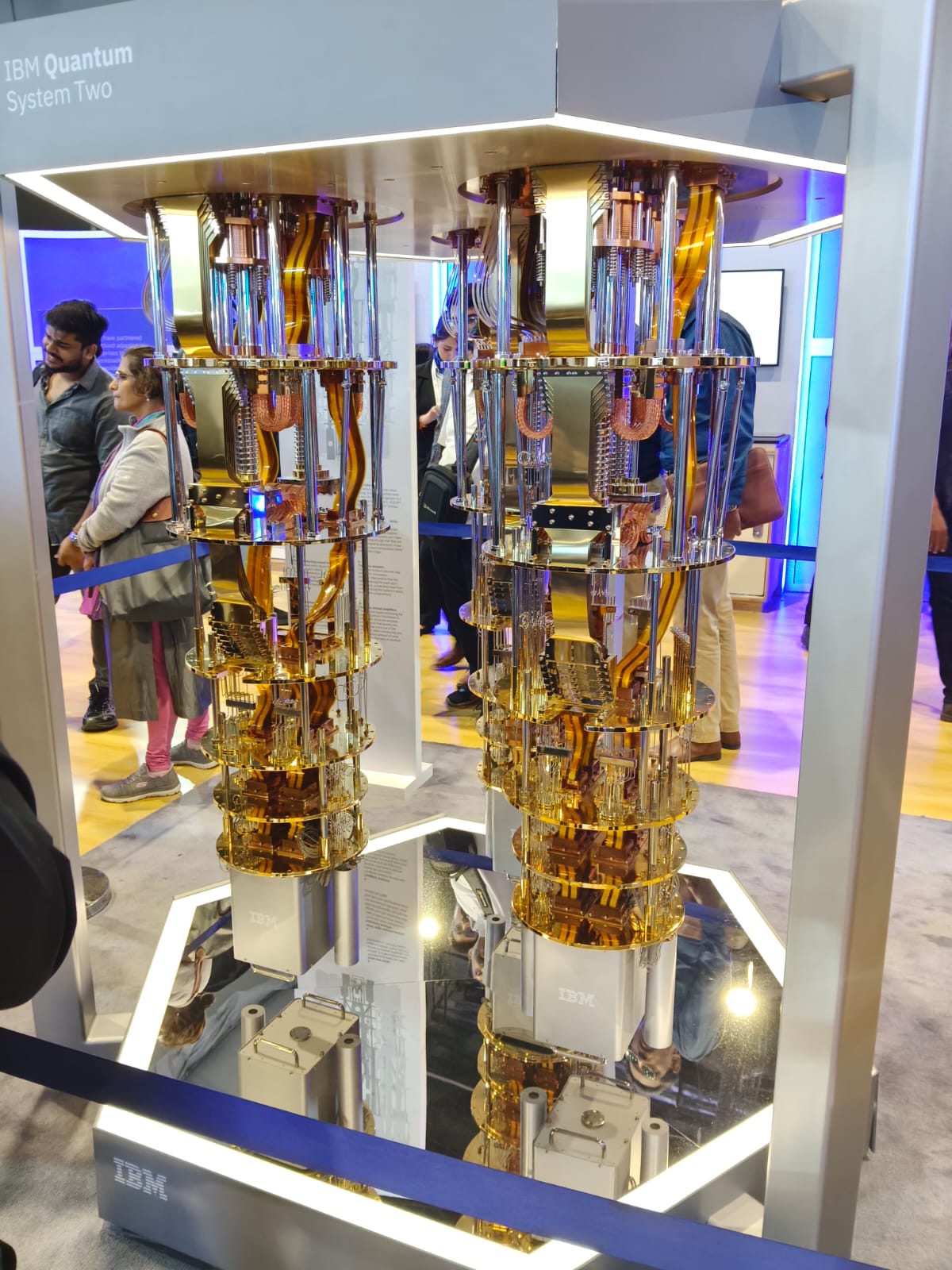
IBM Quantum System Two hardware displayed at a Impact AI SUMMIT New Delhi India 2026, illustrating the complex architecture behind modern quantum computing.
The 15-Minute Result in Perspective
The headline figure—approximately 15 minutes—is certainly striking.
But the deeper significance lies in what made that 15-minute computation possible.
The experiment brought together:
70 logical qubits
2,415 logical two-qubit operations
468 logical T gates
Improved error suppression
A classically difficult computational task
And a method for statistically assessing computational fidelity
Taken together, these elements represent progress across several important areas of quantum computing.
What This Does—and Does Not—Prove
It is useful to separate the demonstrated results from broader expectations about the future.
The experiment demonstrates progress in:
- Logical quantum computing
- Quantum error correction
- Complex quantum circuits
- Verification of difficult quantum computations
- Quantum advantage benchmarking
It does not demonstrate that:
- Quantum computers are universally faster than classical computers
- Classical computers are obsolete
- Every difficult problem can now be solved efficiently with quantum hardware
- Quantum computing is already commercially superior for everyday workloads
- All practical applications of quantum computing have been solved
The difference matters because quantum computing is still a developing technology.
Why This Matters for the Future
If quantum computers eventually become capable of running very large, fault-tolerant circuits, they could potentially transform fields that rely heavily on computation.
Potential areas of interest include drug discovery, molecular simulation, materials science, optimization, cryptography and scientific research.
However, realizing these possibilities will require significant additional progress.
Researchers need machines that can maintain quantum information for long periods, perform enormous numbers of operations with low error rates and provide trustworthy results.
Experiments like this are designed to address exactly those challenges.
Conclusion
The IBM and University of Chicago experiment represents an important milestone in the development of quantum computing.
The quantum computer completed a specialized computational task in approximately 15 minutes, while leading classical simulation techniques would require an impractical amount of time to reproduce the computation.
More importantly, the experiment combined computational difficulty with verification, addressing one of the major challenges in demonstrating quantum advantage.
The use of 70 logical qubits, thousands of logical operations and improved error suppression also demonstrates continued progress toward more reliable quantum systems.
Quantum computers are not yet replacements for classical machines, and this experiment does not mean that every computational problem can now be solved faster using quantum technology.
Instead, the achievement represents progress toward a much more important long-term goal: building quantum computers that can perform increasingly complex calculations reliably, verifiably and at a scale beyond what classical computers can practically achieve.
As researchers continue improving logical qubits, error correction and verification, the focus will gradually shift from proving that quantum computers can outperform classical systems on specialized tasks to demonstrating whether they can deliver meaningful advantages on real-world problems.
That transition—from experimental quantum advantage to practical quantum computing—will be one of the most important developments to watch in the years ahead.
Source: IBM
Comments (0)
Be the first to join the discussion.